
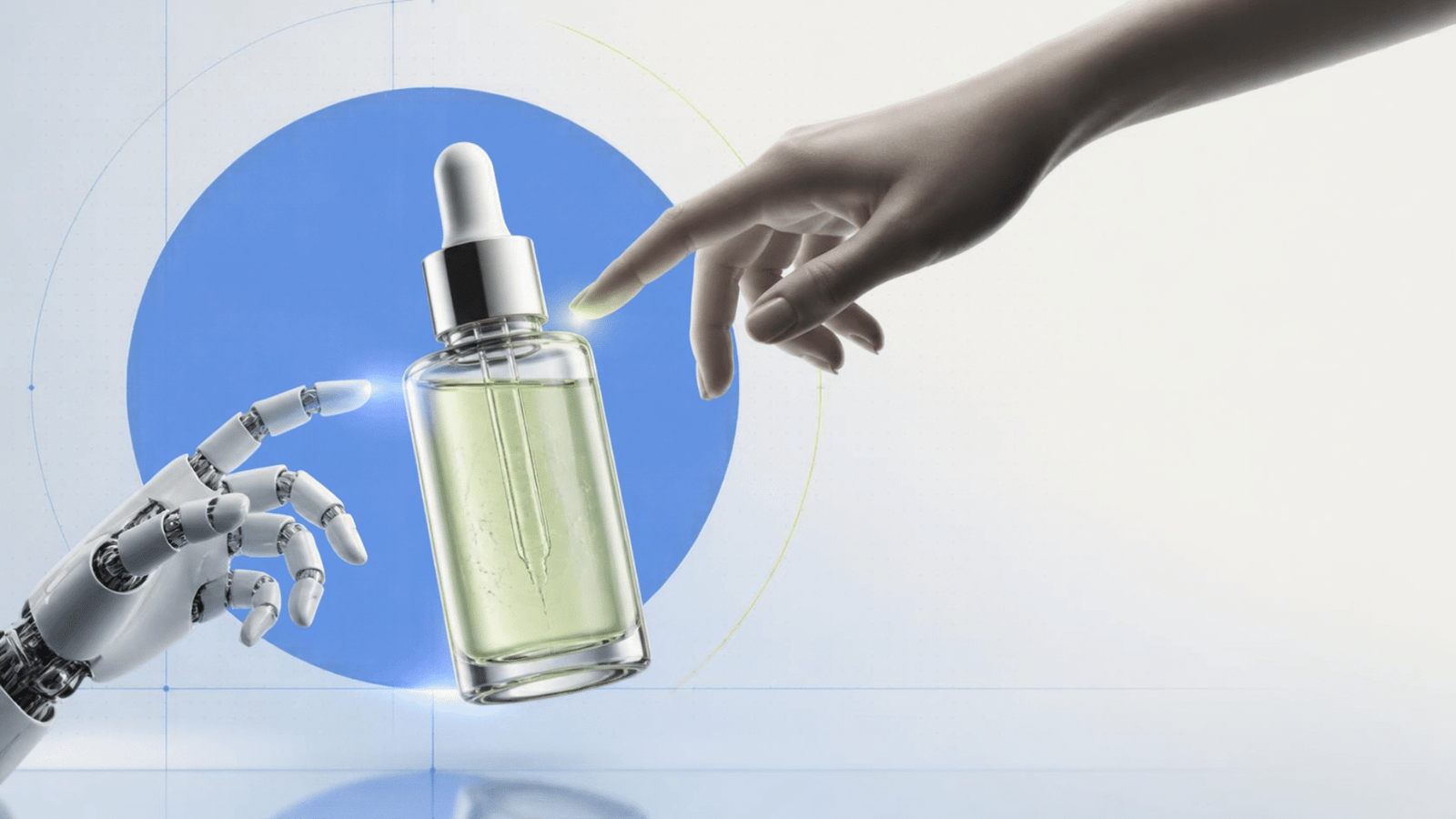
Everyone is talking about AI, and it feels like everywhere you turn, there’s another new AI tool.
The noise is getting louder, and it’s starting to feel overwhelming. From “AI will transform your business” and “AI is the new ingredient” to “The 10 best AI tools for beauty brands,” the message is clear: AI is quickly becoming table stakes for corporations and small businesses alike.
As more consumers rely on AI to discover brands, seek product recommendations, and make purchases, the business case for AI only gets stronger. According to McKinsey, “Gen AI could add $9 billion to $10 billion to the global economy based on its impact on the beauty industry alone” (McKinsey, 2025).
For an indie beauty founder, that raises the question: how can AI make a meaningful impact in my brand’s ecosystem?
In this post, I’ll break down how indie beauty brands can think about AI, where the best use cases are, and what responsible adoption means.
Key Takeaways
- Start with the customer, not the tool. The best first AI use case solves a critical pain point in the customer experience or a repetitive problem for your team.
- Your inputs shape the outputs. Large language models need reliable, current information to represent your brand accurately and credibly. That includes product details, ingredients, clinical trials, packaging and recyclability information, verified claims, policies, customer feedback, and brand voice.
- Responsible adoption requires guardrails. AI should help your brand make better decisions, create value for your customers, and use resources more effectively. It cannot replace human judgment, accountability, or creativity.
Why does AI feel so urgent for beauty brands right now?
AI feels urgent because the customer journey is changing. Consumers no longer rely only on product pages and reviews to discover and purchase products. They increasingly use AI (like ChatGPT, Muse, Claude, or Google Gemini) to compare products, understand ingredients, get routine advice, and narrow down options that suit their needs best.
Unlike traditional search, consumers can ask AI to recommend products based on their location, access to physical stores (for try-on), and other contextual information without compromising their personal preferences. For example, a foundation that will last in humid weather and is cruelty-free, a serum that fits into an existing routine, or a vegan shampoo for sensitive skin and thick Asian hair.
According to Criteo, 38% of consumers use AI assistants on at least some beauty and personal-care shopping trips, and 57% say product recommendations or featured products in AI responses are highly or moderately influential when deciding what to buy (Criteo, Health & Beauty Pulse 2026).

And right now, legacy brands like CeraVe and La Roche-Posay continue to dominate ChatGPT AI search in 2026 (Emarketer, AI Visibility Index 2026).
So, what does that mean for indie beauty brands or early-stage brands where product discovery matters most?
The ways consumers discover and evaluate beauty products are expanding, and brands can do their part by meeting them where they are. Before getting into AI tools and chatbots, it’s crucial for brands, marketers, and team leads to identify and prioritize where they can make the most impact on customer experience, revenue, cost, or time (McKinsey, “How Beauty Players Can Scale Gen AI in 2025”).
Before shopping for AI tools, brands should identify what problem they’re aiming to solve. I often hear from founders what sustainability tools to use, and my answer always ties back to the impact the brand wants to make.
What is generative AI?
Generative AI (genAI) creates text, images, and other content in response to instructions or prompts you give it. For a beauty brand, that could be drafting an email, summarizing reviews, or exploring packaging concepts. Large language models, or LLMs, power many tools that interpret and generate that text.
In beauty, AI tools include:
- Generative AI tools: help create and refine content, from PDPs (product detail pages) and customer-service responses to campaign concepts and packaging visuals.
- Virtual try-on (VTO): a combination of AI and augmented reality to let shoppers preview color cosmetics or other products. VTO can be powered by generative AI.
- Agentic AI assistants: similar to an administrative or customer service assistant, agentic AI tools can help you plan, make decisions, and execute workflows with your permission.
How does your brand information support AI visibility?
To represent your brand accurately, an LLM-powered assistant needs more than product descriptions. It needs your brand’s knowledge ecosystem.
Here’s a snapshot of how to increase AI visibility for your beauty brand:
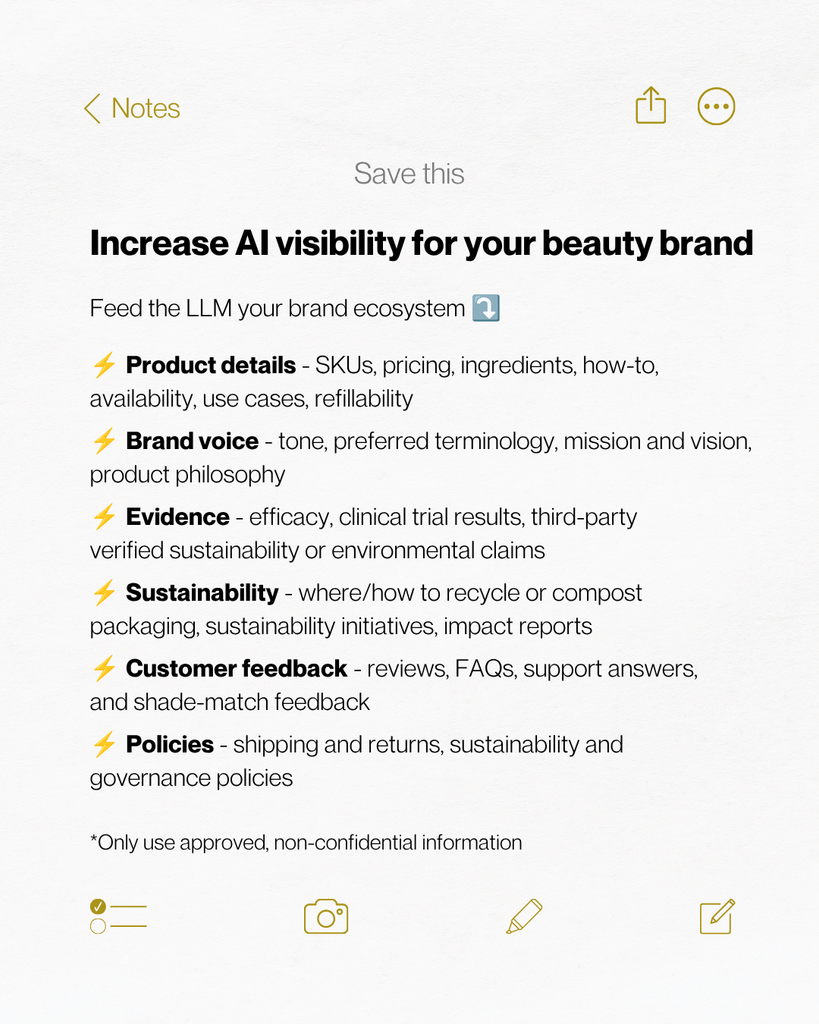
Your brand ecosystem includes: product details, ingredients, clinical trials, packaging and recyclability information, verified claims, policies, customer feedback, and brand voice. Before feeding information to the LLM, ensure information is current, complete, and consistent.
✨ If you’re a clean or conscious beauty brand looking to strengthen your sustainability story, a Conscious Brand Audit can help. I’ll review how you communicate your brand’s impact across your website and social channels, highlighting what’s working and where there’s an opportunity to make your message clearer before sharing that information with your AI tool.
What should an indie beauty brand use AI for?
Most indie beauty brands should begin with a repetitive, low-risk task that already creates a specific problem for the customer or the team. The first question you should ask is, “Where is friction costing my brand customer confidence, time, or revenue?”
McKinsey’s research narrowed it down to four high-value areas for genAI in beauty:
- Hyperpersonalized marketing
- Product discovery
- Customer service
- Faster product development
The brands that can clearly explain who a product is for, what it does, how to use it, and why a customer might choose it are better positioned to show up where and when the decision takes place.
|
If this is a problem… |
Start here |
|---|---|
|
You have lots of reviews, DMs, and customer questions, but no time to make sense of them |
➡️ Customer feedback analysis |
|
You spend too much time starting emails, captions, or campaign content from scratch |
➡️ Content and campaign support |
|
Your team answers the same shipping, returns, or product questions again and again |
➡️ Customer-service knowledge base |
|
Your customers are unsure which product, shade, or routine is right for them |
➡️ Product discovery support |
|
Your customers cannot easily find sustainability-related information about your company and products |
➡️ Sustainability data organization |
|
You have sales, marketing, and customer data, but no time to turn it into decisions |
➡️ Reporting and planning support |
|
You need a quicker way to research ingredients, experiment with formulas, and develop briefs around new ideas for products or packaging |
➡️ Innovative product development |
If you’re still wondering how AI can help your beauty brand, I summarize key takeaways and examples from brands like Supergoop!, Jane Iredale, and more in my LinkedIn post here. For example, Jane Iredale saw a 10% higher average order value (AOV) after implementing AI-driven product recommendations.
You don’t need expensive AI tools for every task. However, you do need to understand what customer problem you’re solving for. Are they having trouble finding the right shade? Or are they searching for more product information?
Either way, the answer always points back to understanding the customer, reducing friction, and adding value to their experience. Once you’ve picked a starting point, the next question is how to use AI responsibly.
How can AI support a more responsible beauty business?
AI can support a more responsible beauty business when it can help customers make informed choices, reduces repetitive work, improves access to accurate information, and supports better business decisions.
But those benefits come with trade-offs. The data centers that support AI require a significant amount of electricity and, depending on their cooling systems, water. Their environmental impact varies with location, energy supply, and the technology used (I dive into the environmental impact of AI and what it means for you in later posts).
Whether a business decides to use AI (or any technology, for that matter) is a question of purpose. What problem does it solve? What value does it create? What costs or risks come with it?
For an indie beauty brand, that means choosing solutions that offer specific benefits, rather than adding AI to every single workflow. For example: Automation could help teams shift their time toward higher-value tasks. AI assistance for product development could help teams explore ways to reduce product and materials waste, and VTOs could help some brands reduce product returns, as sustainability increasingly becomes a business imperative.
However, those gains are measured differently. Whether it’s time saved, waste reduced, or fewer returns, brands should track results against investments in AI tools. A tool that helps one brand may not help another, so measuring your own results matters — a fundamental approach to sustainability.
Before implementing AI, ask yourself:
- Does it solve a real customer or team problem?
- Does it reduce repeated work, decision fatigue, or avoidable friction?
- Are its answers accurate, explainable, and regularly reviewed?
- Is customer data being handled with appropriate care and consent?
- Can you support the product and sustainability information it shares?
- Is the value it creates meaningful enough to justify its financial and resource cost?
AI can’t replace everything. So where does human expertise matter?
AI cannot replace human creativity, judgment, strategy, or accountability. You still decide how your brand and products show up in the world. Moving faster matters when it moves you toward a business you are proud to build, not when it takes you farther from your raison d’être or core purpose.
If you’ve built your brand with intention, bring that same approach to AI. Start small, keep it simple, and stay connected to what you want to achieve.
👩🏻💻 I’m passionate about helping beauty founders turn sustainability commitments into practical action through sustainability strategy and ethical brand marketing. If you’re curious about what a partnership could look like, explore ways to work with me or learn more about me.
FAQs
Do small beauty brands need AI?
No. A small beauty brand does not need AI simply because competitors use it. AI is worth exploring when it solves a clear customer or operational problem, such as repetitive support questions, scattered customer feedback, or difficult product discovery.
What is the best AI use case for an indie beauty brand?
The best first use case is usually a low-risk, repeatable workflow that already takes significant time. For many brands, it could be analyzing reviews and customer questions, creating content, or improving a self-service knowledge base.
Can AI help my beauty brand reduce returns?
AI-guided product discovery, shade matching, and routine guidance may help customers make more informed choices, which can lead to fewer returns. Results depend on the brand, the products, and the AI technology you adopt.
Can AI answer customer questions about ingredients?
AI can help answer ingredient and product questions when it has verified and approved brand information. It should not provide medical guidance, diagnose skin or health conditions, make unapproved safety or efficacy claims, or replace a person for high value concerns or questions.
Can AI substantiate sustainability claims for my brand?
AI can help organize data and evidence, but it cannot independently validate or substantiate a supplier’s documentation, environmental claim, or decide whether an environmental claim follows regulations.
How do I know whether an AI investment is worth it?
Focus on the problem you aim to solve. Then decide if an investment in AI tools could meaningfully act as a solution and add value to your business. Choose one outcome, such as time saved, customer-service quality, assisted conversion, fewer repetitive questions, or faster insight generation.